

Vehicle Roadside Assistance Market Share register a CAGR of 5.18% to Reach USD 67.48 Billion by 2035
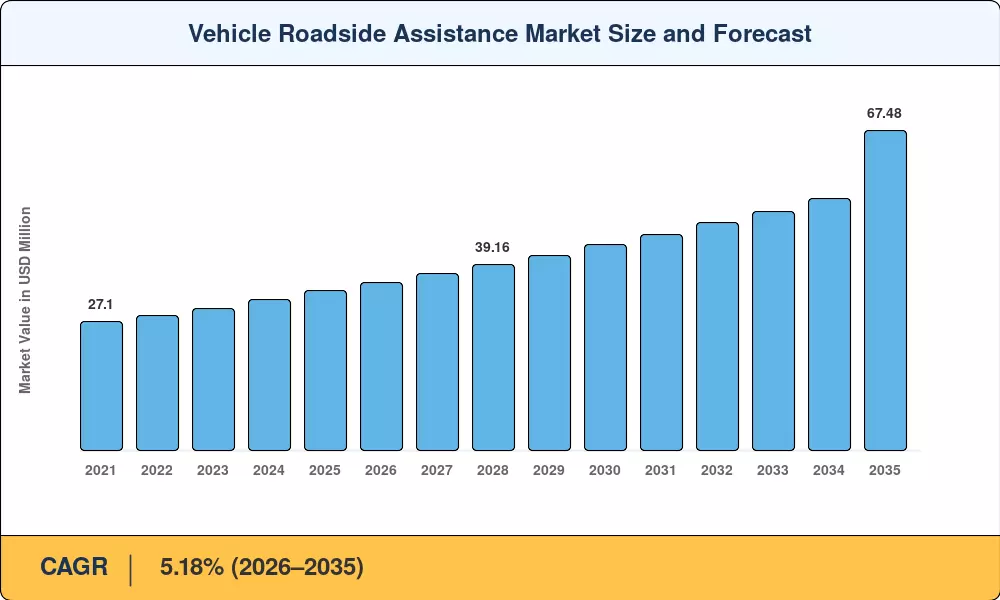
Vehicle Roadside Assistance Market Summary
Vehicle Roadside Assistance Market to Reach USD 67.48 Billion by 2035 as Expanding Vehicle Fleet and Digital Mobility Services Accelerate Demand
NY, CA, UNITED STATES, June 11, 2026 /EINPresswire.com/ -- The global Vehicle Roadside Assistance Market stood at USD 33.72 billion in 2025 and is projected to grow from USD 35.38 billion in 2026 to USD 67.48 billion by 2035, registering a CAGR of 5.18% during the forecast period (2026–2035). Rising vehicle ownership, increasing roadside emergency incidents, and growing consumer preference for fast-response mobility support services are expected to drive market expansion globally.The global vehicle roadside assistance market growth is experiencing stable growth as consumers increasingly prioritize uninterrupted mobility, driver safety, and rapid emergency support services. Vehicle roadside assistance solutions have evolved into an essential component of the automotive ecosystem, helping drivers manage unforeseen breakdowns through towing, battery jump-starts, tire replacement, fuel delivery, lockout assistance, flatbed towing, and accident recovery services.
Growing vehicle dependency among consumers, increasing commuting distances, and rising ownership of passenger and commercial vehicles continue to create strong demand for dependable roadside support systems. As vehicle populations expand globally, roadside service providers are strengthening operational networks and adopting technology-driven service models to improve customer response times and overall service efficiency.
The increasing complexity of modern vehicles is also contributing to greater demand for specialized roadside assistance. Advanced vehicle technologies, including electronic systems, connected diagnostics, and electric mobility platforms, have increased the need for professional support solutions capable of handling a broader range of roadside emergencies.
Additionally, rising customer expectations for convenience and reliability are encouraging service providers to improve digital accessibility through mobile applications, GPS-enabled assistance tracking, and real-time communication systems.
Competitive Landscape
The vehicle roadside assistance market remains competitive, with service providers focusing on faster response times, wider geographic coverage, and improved digital service capabilities.
Key companies operating in the market include AAA, Allstate Roadside Services, Agero, RAC, Nationwide Assistance, BCAA Roadside Assistance, Good Sam Roadside Assistance, Roadside Masters, and Emergency Roadside Assistance. Companies continue investing in mobile platforms, customer support technologies, and partnership-driven service expansion to strengthen market positioning.
Ask for Sample PDF - https://www.marketresearchfuture.com/sample_request/26619
Growing Vehicle Fleet Creating Strong Demand for Emergency Assistance Services
One of the primary drivers supporting the growth of the vehicle roadside assistance market is the rapid increase in the global vehicle fleet. Rising disposable income, urbanization, expanding transportation infrastructure, and increasing automotive accessibility continue to contribute to higher vehicle ownership worldwide.
As the number of vehicles on roads grows, roadside emergencies such as battery failures, punctures, mechanical breakdowns, fuel shortages, and lockouts are becoming increasingly common. Consumers are therefore showing greater interest in roadside assistance memberships and subscription-based emergency services that ensure faster vehicle recovery and reduced travel disruptions.
The increasing use of vehicles for both personal and commercial transportation purposes is also expected to support long-term market demand. Commercial transportation providers and logistics operators are increasingly adopting roadside assistance solutions to minimize vehicle downtime and improve operational continuity.
Furthermore, the rising age of vehicle fleets across several markets has created additional opportunities for roadside service providers, as older vehicles generally require more frequent emergency assistance and maintenance-related interventions.
Digital Transformation Reshaping Roadside Assistance Services
Technology integration is becoming one of the most influential trends within the vehicle roadside assistance market. Traditional roadside assistance models are increasingly transitioning toward digitally connected service ecosystems designed to improve customer experience and response efficiency.
Mobile application-based assistance services are gaining popularity as consumers increasingly prefer quick, seamless service access through smartphones. Digital platforms now allow users to request roadside assistance, monitor technician locations, receive estimated arrival times, and access service updates in real time.
GPS-enabled dispatch systems are helping providers improve technician allocation and reduce emergency response times. These systems enhance operational efficiency while improving customer satisfaction by enabling faster issue resolution.
Connected vehicle technologies are also beginning to transform roadside support models. Vehicles equipped with telematics and onboard diagnostic systems can provide real-time vehicle information, helping roadside service teams identify mechanical issues more efficiently.
As connected mobility ecosystems continue to evolve, predictive maintenance and intelligent roadside support solutions are expected to emerge as important areas of future market development.
Insurance Providers and Vehicle Manufacturers Expanding Service Partnerships
Strategic collaborations among insurance providers, automobile manufacturers, and independent roadside assistance operators continue to play a significant role in market growth.
Insurance companies are increasingly incorporating roadside assistance as part of vehicle insurance packages to strengthen customer retention and improve service offerings. These programs commonly include towing, fuel delivery, battery support, lockout assistance, and accident recovery services.
Automobile manufacturers are also expanding their roadside support capabilities through warranty-linked emergency assistance programs. Many automakers now include complimentary roadside assistance coverage for newly purchased vehicles to improve ownership experience and customer loyalty.
Independent roadside assistance companies continue to strengthen their market presence through expanded service networks, local repair partnerships, and improved geographic coverage.
As mobility ecosystems become increasingly service-oriented, integrated roadside support offerings are expected to become a more important component of vehicle ownership experiences worldwide.
Browse Premium Research Insights - https://www.marketresearchfuture.com/reports/vehicle-roadside-assistance-market-26619
Segment Analysis
The vehicle roadside assistance market is segmented by service type, vehicle type, roadside assistance provider, assistance channel, value-added services, and region.
Based on service type, the market includes towing, tire repair and replacement, fuel delivery, battery jump-start, lock-out assistance, flatbed towing, and accident recovery. Towing services account for a substantial share of the market due to the increasing occurrence of mechanical breakdowns and road accidents. Battery jump-start and tire replacement services are also witnessing strong demand due to rising vehicle dependency and growing commuting activity.
Fuel delivery and lock-out assistance services continue to support market expansion by offering convenience-driven emergency solutions for consumers facing unexpected disruptions during travel.
By vehicle type, the market is segmented into passenger cars, light commercial vehicles, heavy commercial vehicles, and motorcycles. Passenger cars represent a major share of market demand due to increasing ownership and daily vehicle utilization. However, light and heavy commercial vehicles are expected to experience notable growth due to expanding logistics and transportation activities globally.
Motorcycles are also emerging as an important segment in several developing economies where two-wheeler ownership remains high.
Based on roadside assistance provider, the market includes insurance companies, auto clubs, car manufacturers, and independent providers. Insurance companies continue to maintain strong market positioning due to their broad customer base and bundled roadside assistance offerings. Auto clubs also play an important role in market development by providing membership-based support services.
Car manufacturers are increasingly strengthening roadside assistance programs to improve customer satisfaction and enhance brand loyalty, while independent providers continue expanding through regional partnerships and digital service platforms.
The market is also segmented by assistance channel, including telephone, mobile application, website, and roadside assistance app. Mobile application-based services are expected to witness increasing adoption as customers prioritize convenience, accessibility, and faster response times.
Based on value-added services, the market includes vehicle diagnostics, emergency medical assistance, roadside safety checks, and vehicle inspection. Vehicle diagnostics services are gaining importance as connected vehicle technologies continue to improve service accuracy and roadside troubleshooting efficiency.
Regional Insights
North America continues to represent an important regional market due to high vehicle ownership, advanced transportation infrastructure, and strong consumer awareness regarding roadside assistance services. The region also benefits from established insurance ecosystems and mature emergency support networks.
Europe maintains a strong market position supported by rising vehicle ownership, well-developed road networks, and growing demand for reliable emergency assistance services. The presence of established roadside support organizations and insurer-backed assistance programs continues to support regional market development.
Asia-Pacific is expected to witness substantial growth during the forecast period due to increasing automobile ownership, rapid urbanization, and growing middle-class populations. Countries such as China, India, Japan, and South Korea continue to contribute significantly to regional market expansion.
Increasing smartphone penetration and digital service adoption are also expected to accelerate app-based roadside assistance services across emerging Asia-Pacific economies.
Meanwhile, Latin America and the Middle East & Africa are expected to experience gradual market growth due to improving transportation infrastructure and increasing awareness regarding emergency roadside support services.
Ask for Customization - https://www.marketresearchfuture.com/ask_for_customize/26619
Future Outlook
The future outlook for the vehicle roadside assistance market remains positive as vehicle ownership continues to increase and customer expectations surrounding mobility convenience continue evolving.
Growing adoption of connected vehicles, rising smartphone usage, and increasing consumer demand for immediate roadside support are expected to create new growth opportunities across global markets.
As roadside assistance providers continue investing in digital technologies and expanding service accessibility, emergency mobility services are expected to become increasingly efficient, personalized, and technology-enabled.
Supported by a growing global vehicle parc, increasing demand for convenience-driven services, and expanding digital roadside assistance ecosystems, the global Vehicle Roadside Assistance Market is projected to reach USD 67.48 billion by 2035, maintaining steady long-term growth momentum.
Other Related Resrearch Reports:
https://www.marketresearchfuture.com/reports/hydrogen-fuel-cell-vehicle-market-4722
https://www.marketresearchfuture.com/reports/electric-vehicle-motor-market-5385
https://www.marketresearchfuture.com/reports/recreational-vehicles-market-7537
https://www.marketresearchfuture.com/reports/used-vehicle-market-7616
https://www.marketresearchfuture.com/reports/light-commercial-vehicles-market-7726
https://www.marketresearchfuture.com/reports/electric-vehicle-battery-recycling-market-8326
https://www.marketresearchfuture.com/reports/india-electric-vehicle-market-12671
https://www.marketresearchfuture.com/reports/software-defined-vehicle-market-13918
https://www.marketresearchfuture.com/reports/us-electric-vehicle-charging-infrastructure-market-17222
https://www.marketresearchfuture.com/reports/china-electric-vehicle-charging-station-market-21365
Larry Wilson
WantStats Research And Media Pvt. Ltd.
+1 855-661-4441
email us here
Visit us on social media:
LinkedIn
Facebook
YouTube
X
Legal Disclaimer:
EIN Presswire provides this news content "as is" without warranty of any kind. We do not accept any responsibility or liability for the accuracy, content, images, videos, licenses, completeness, legality, or reliability of the information contained in this article. If you have any complaints or copyright issues related to this article, kindly contact the author above.
